Using Chores to Build Responsibility and Self-Belief
3 October 2026
Let me paint a picture. It is Saturday morning. You are standing in a kitchen that looks like a cereal box exploded. There are socks on the couch. Somewhere, a child is watching a screen with the intensity of a bomb disposal technician. You ask that child to take out the trash. The child sighs as if you have asked them to manually dig a canal with a spoon.
Every parent knows this scene. And most parents respond to it in one of two ways. Either they give up and do the chore themselves because it is faster, or they launch into a lecture about gratitude that nobody enjoys, least of all them.
Here is the thing nobody tells you. That trash bag is not really about trash. It is one of the most powerful tools you have for building a human being who believes in their own competence. Chores are not a punishment. They are not free labor. Done right, they are a slow, steady investment in a kid's sense of self.
This article is about how to make that investment wisely, and how to avoid the traps that turn a good idea into a daily battle.

Why Chores Matter More Than Most Parents Realize
There is a common belief that childhood should be carefree and that responsibility is something you grow into later. This sounds warm and generous. It is also a mistake.Think about what a chore actually teaches a child. When a six year old sets the table, they learn that their actions affect other people. When a ten year old folds laundry, they learn that mastery takes repetition. When a teenager cooks dinner for the family, they learn that they are capable of contributing something real.
None of these lessons can be delivered through a lecture. They have to be experienced. A child who is told "you are responsible" learns nothing. A child who is trusted with a real task and completes it learns everything.
There is another layer here, and it is the one parents miss most often. Chores build self-belief, not just obedience. Those are very different outcomes. Obedience produces a child who does what they are told. Self-belief produces a young adult who trusts their own hands and judgment. The second one is what you actually want.
The Difference Between Helping and Belonging
Many families treat chores as optional favors. The child "helps" mom. This framing feels kind, but it quietly communicates something unhelpful: the work belongs to the adult, and the child is a guest.A better frame is contribution. The child is not helping you. The child is doing their part in a household that runs on everyone's effort. This shift sounds small. It changes everything.
When chores are framed as belonging, kids stop seeing them as a tax and start seeing them as membership. They are not outsiders doing favors. They are insiders carrying weight. That is a completely different emotional experience.

The Self-Belief Engine: What Is Actually Happening in a Child's Brain
You do not need a neuroscience degree to understand why chores work. You just need to notice a pattern that shows up in almost every child.A child attempts something. They struggle. They get it slightly wrong. They adjust. They succeed. Something in them quietly files away a new belief: I can figure things out.
Psychologists sometimes describe this as self-efficacy, which is a fancy way of saying "the belief that your actions produce results." It is not the same as self-esteem. Self-esteem is how you feel about yourself. Self-efficacy is whether you think you can do things.
You can praise a child all day and inflate their self-esteem without ever building self-efficacy. Praise is cheap. Competence is earned. Chores are one of the few reliable ways to let a child earn it.
Why Easy Chores Do Not Build Much
Here is a counterintuitive point. A chore that is too easy does not build much of anything. If a child can do it without thinking, it becomes boring and meaningless.The sweet spot is a task that is slightly beyond their current skill. Not so far that they fail, but far enough that they have to concentrate. A seven year old learning to crack eggs will make a mess. That mess is the point. They are building a skill at the edge of their ability, and the edge is where growth happens.
This is why you should resist the urge to only assign chores your child has already mastered. Mastery is comfortable. Comfort does not build self-belief.
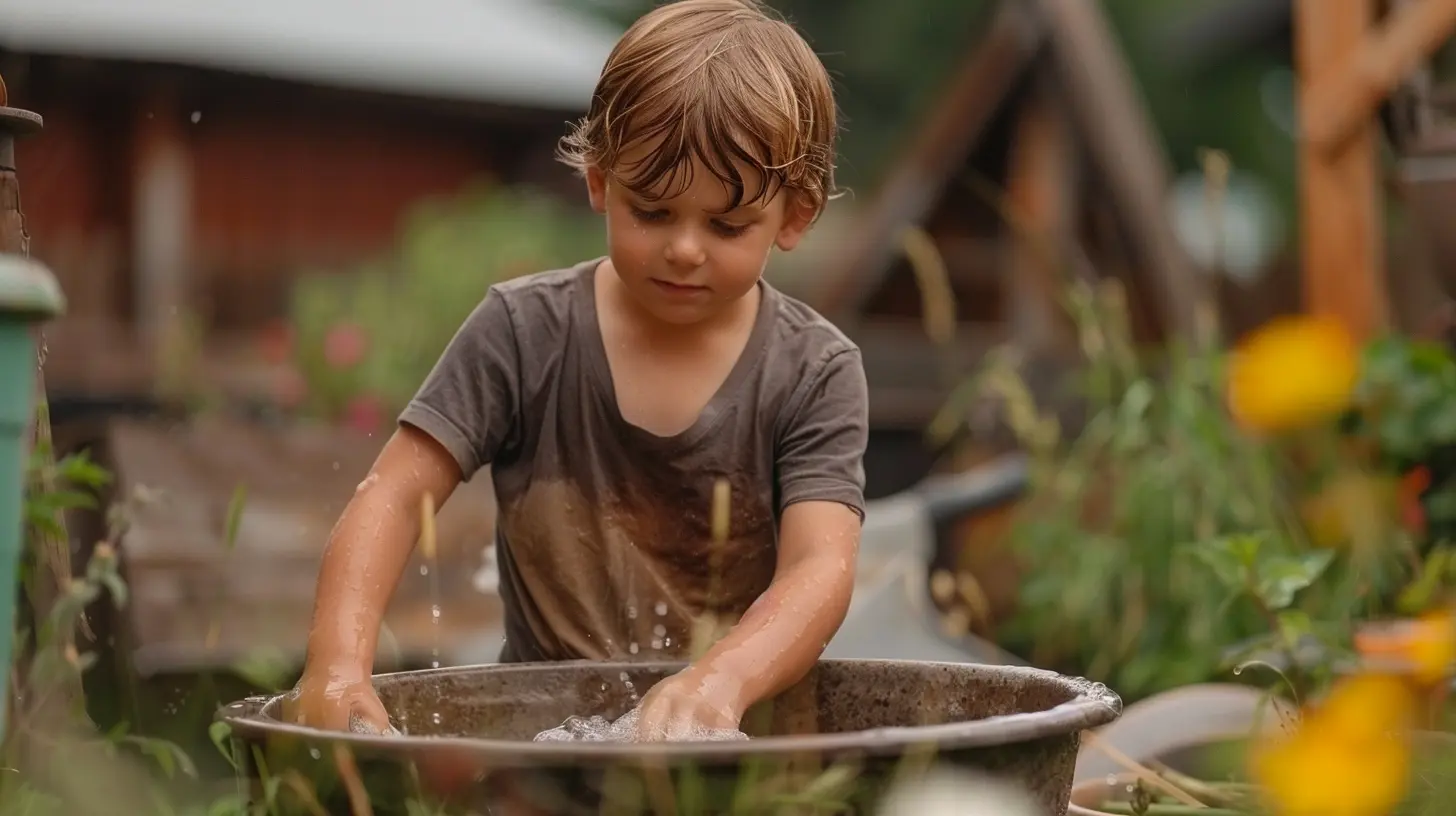
Choosing the Right Chores for the Right Age
Age matters, but not in the rigid way many charts suggest. What matters more is the combination of physical ability, attention span, and safety.Here is a rough framework you can adapt, not a rulebook.
Ages 2 to 4: Participation, Not Perfection
Toddlers cannot really clean. They can, however, participate. Putting toys in a bin. Wiping a spill with a rag. Carrying a lightweight item to the trash.The goal at this age is not the result. It is the ritual. You are teaching them that they are part of the team. Expect it to take three times as long and produce half the result. That is fine. You are not optimizing for a clean floor. You are optimizing for a habit.
Ages 5 to 8: Real Tasks With Real Stakes
This is where chores become genuinely useful. Setting the table. Feeding a pet. Matching socks. Watering plants. Putting away their own laundry.At this stage, kids can follow multi-step instructions and take pride in doing something correctly. This is also when you should start resisting the urge to redo their work. If you refold the towel they just folded, you have just told them their effort was worthless. Let the lumpy towel live.
Ages 9 to 12: Independence and Ownership
Now you can hand over whole categories of work. Loading the dishwasher. Taking out all the trash. Vacuuming a room. Making a simple breakfast.The key shift here is ownership. Instead of assigning tasks, assign domains. "You are in charge of the recycling" is more powerful than "take out the recycling today." Ownership builds identity. The child becomes the person who handles that thing.
Ages 13 and Up: Real Contribution
Teenagers can and should do adult-level tasks. Cooking a meal for the family. Mowing the lawn. Doing their own laundry start to finish. Managing a small budget for a household errand.This is also the age where chores start to overlap with life skills. A teenager who can cook four meals, do their own laundry, and manage a basic schedule is a teenager who is ready to leave home. That is the entire point.

The Mechanics: How to Set Up a Chore System That Actually Works
Most chore systems fail. Not because the kids are lazy, but because the system was never designed properly. Here is what separates the ones that stick from the ones that collapse in two weeks.Make It Visible
Out of sight is out of mind, especially for kids. A written list on the fridge, a whiteboard, or a simple chart does more than any amount of reminding.The chart should show who does what and when. It should be readable by the child without help. If your six year old cannot tell what they are supposed to do by looking at it, the chart is decoration.
Set a Clear Standard
"Clean your room" means nothing to a child. "Clean your room" to you might mean vacuumed floors and organized drawers. To them it might mean "floor is visible."Define the standard explicitly. "Clean room" might mean: bed made, clothes in the hamper, floor clear, desk wiped. Now the child knows what done looks like. This removes an enormous amount of conflict.
Build in a Deadline
Chores without deadlines drift forever. "Do it sometime today" becomes "do it at 9 PM when I am already annoyed." Give a specific window. "Before dinner" or "by 5 PM" works well. It gives the child control over when, which they value, while keeping the outcome firm.Decide on Consequences in Advance
This is where most parents improvise badly. They get frustrated in the moment and either explode or give up. Neither teaches anything.Decide now what happens if a chore is not done. Maybe screen time is paused until it is. Maybe a privilege is delayed. The consequence should be reasonable, related, and consistent. It should not be a surprise.
Do Not Pay for Everything
Allowance and chores are a controversial topic, and both approaches have real trade-offs.Paying for chores teaches kids that work has value. It also mirrors the real world. The downside is that it can turn family contribution into a transaction. A child who is paid for every task may eventually refuse to do anything unpaid.
A balanced approach works for many families. Basic chores that come with being part of the household are unpaid. Extra tasks beyond the basics can be paid. This preserves the idea of contribution while still offering a chance to earn.
There is no universally correct answer. What matters is that you pick one and apply it consistently.
Common Mistakes Parents Make
Even well-meaning parents sabotage their own chore systems. Here are the most frequent errors, and why they backfire.Redoing the Child's Work
This is the most damaging mistake, and it is almost always done with good intentions. You see a poorly folded shirt and you refold it. You see streaks on the mirror and you wipe them away.The message the child receives is clear: your effort was not good enough. Do not bother trying. Over time, they stop trying. Why would they, when the work gets redone anyway?
If the result is genuinely unacceptable, teach the skill again. Do not silently correct it.
Assigning Chores as Punishment
The moment a chore becomes a punishment, it stops being a contribution. It becomes a sentence. Kids learn to resent the task and, by extension, the household.Chores should be a normal, neutral part of family life. They should happen whether the child is in trouble or not. If you need a consequence for misbehavior, use something else.
Being Inconsistent
The chore chart goes up in January. By March it is buried under a school flyer. By June it is gone. The child has learned that chores are a temporary enthusiasm, not a real expectation.Consistency is boring, but it is the entire game. A simple system you actually maintain beats an elaborate system you abandon.
Expecting Adult Quality From a Child
A nine year old will not clean a bathroom the way you do. A twelve year old will not fold laundry the way you do. This is fine. The goal is progress, not perfection.Standards should rise with skill. If you demand adult quality from the start, you will get frustration and quitting.
Doing Everything Yourself Because It Is Faster
It is faster. That is true. It will always be faster. And it will always rob your child of a chance to grow.The short-term efficiency of doing it yourself comes at a long-term cost. You are trading five minutes today for a young adult who cannot handle basic life tasks. That is a bad trade.
Real-World Scenarios: How This Plays Out
Abstract advice is easy. Let us look at how this actually works in real families.Scenario 1: The Reluctant Seven Year Old
Your seven year old refuses to put away their toys. You have asked three times. You are losing patience.Instead of escalating, try changing the frame. "Toys need to be put away before we read books. That is the rule." Then follow through. No anger, no lecture. Just the rule.
The first few times will be painful. Your child will test whether the rule is real. If you hold the line calmly, they learn that the rule is not negotiable. If you cave, they learn that persistence works.
Scenario 2: The Teenager Who Does Not Care
Your fourteen year old does the bare minimum and does not seem to care about the standard. This is common and frustrating.The first thing to check is whether the standard was ever clearly defined. If "clean the kitchen" was vague, they may genuinely believe they are done.
The second thing to check is whether there are real consequences. If nothing happens when the chore is skipped, the chore is optional. Teenagers are excellent at detecting optional tasks.
The third thing to consider is whether the chore is meaningful. A teenager who feels like a servant will resist. A teenager who feels like a contributor with real responsibility will often rise to the occasion. Give them something that matters.
Scenario 3: The Perfectionist Parent
You want things done right. You have high standards. This is not a flaw, but it can become one.If your child's effort never meets your bar, they will stop offering effort. You have to decide what matters more: a perfectly folded towel, or a child who believes they are capable. Those two goals sometimes conflict, and you have to choose.
Chores and the Long Game
It is easy to lose sight of why you are doing this. On a Tuesday afternoon, when you are tired and the kitchen is a disaster, the point of chores can feel very small.But zoom out. What you are really building is a person who can take care of themselves and others. A person who does not crumble when a task is hard. A person who believes that their effort matters.
That belief does not come from a single conversation. It comes from hundreds of small moments where a child did something real and discovered they could.
Chores are not glamorous. They will not show up in a highlight reel. But they are one of the most reliable, most honest tools you have for building a capable human being.
Practical Starting Points
If you are starting from zero, here is a simple way to begin.Pick three chores. One that is daily, one that is weekly, and one that is a personal responsibility. Write them down. Show your child. Explain the standard. Set a deadline. Decide the consequence.
Then hold the line for two weeks. Do not add anything new. Do not redesign the system. Just hold the line.
After two weeks, evaluate. What worked? What did not? Adjust one thing at a time.
The goal is not a perfect system. The goal is a system that survives contact with real life. Simple systems survive. Complicated ones do not.
Final Thoughts
Chores are not about getting help around the house, though that is a nice side effect. They are about teaching a child that they are capable, that their effort matters, and that they belong to something bigger than themselves.That lesson cannot be delivered in a single conversation. It has to be lived. It has to be repeated. It has to be held steady even when it is inconvenient.
Do it well, and you will not just have a cleaner house. You will have a child who believes in their own two hands. That is worth every argument over the trash.
all images in this post were generated using AI tools
Category:
Raising Confident KidsAuthor:

Steven McLain